
Barnet Southgate College
Organisation’s bio: Barnet Southgate College supports learners with a wide range of complex needs through its Pathway Centre, focusing on communication, independence, and life skills development.
Barnet Southgate College

Teenagers and young adults
Not specified
Interactive learning sessions (communication, numeracy, music & movement)
Learners with PMLD, complex needs, autism, and visual impairments
How do you use Cosmo at your organisation?
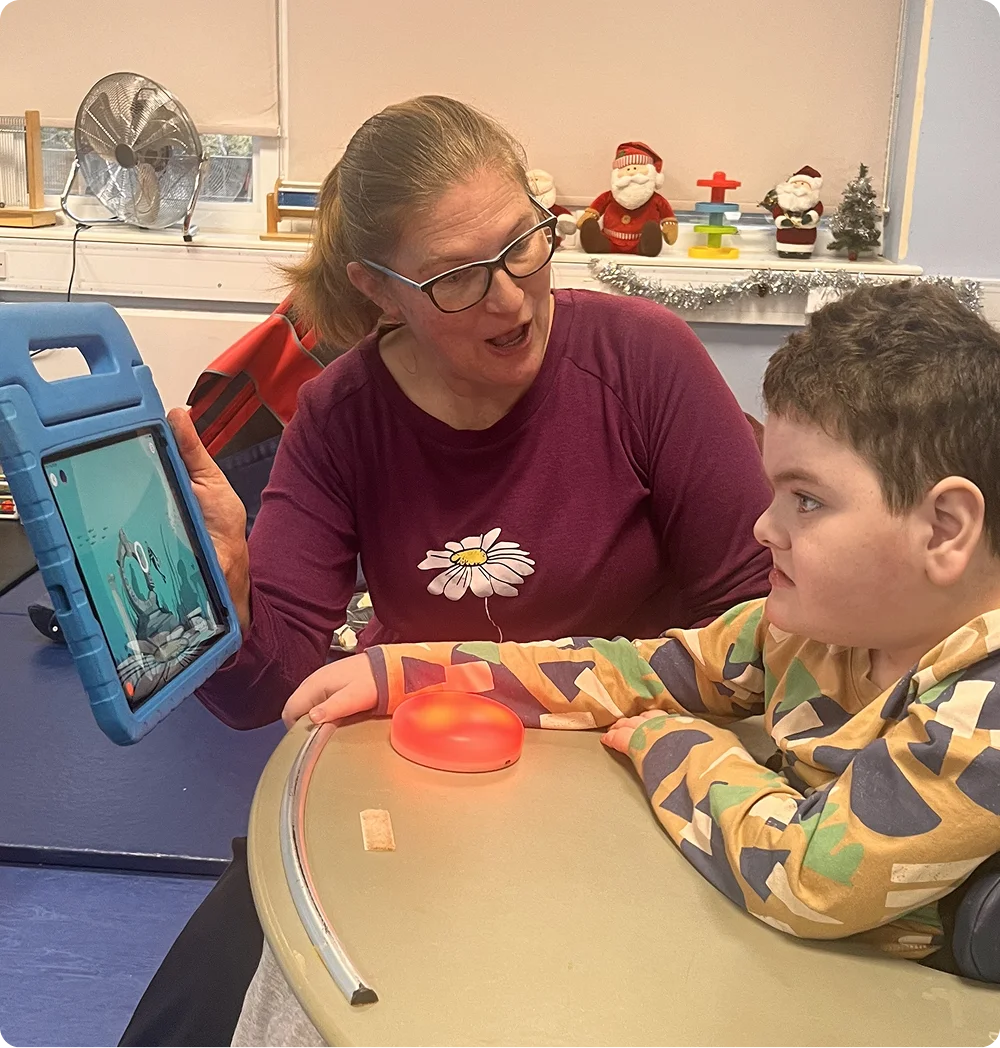
Cosmo has been used at the college for over a year, with some staff using it for up to two years.
Initially, it was used once or twice a week while staff learned how to adapt it. Over time, it has become more embedded in lessons, particularly for:
- Communication
- Interactive play
- Activity-based learning
Teachers also use Cosmo as a break from academic tasks, creating space for more engagement and interaction.
What was the aim of using Cosmo?
The aim was to help learners express themselves, improve communication, actively participate in lessons and give learners cause and effect experiences, encouraging them to take part actively rather than just pointing — especially those who struggle with traditional methods.
How was Cosmo used?
Daniela combined Cosmo with Colourful Semantics to help students build simple sentences using colour-coded meaning.
“Each colour means something—who is doing what… combining Cosmo with Colourful Semantics was absolutely the best and brilliant thing to put together.”
Cosmo was also used for:
- Counting and numeracy activities
- Cause-and-effect learning
- Music and movement sessions
In music, Cosmo enabled participation for learners with limited mobility:
“Some of them are not able to clap… but just to lift their hand and press the Cosmo—that’s the best option and they take part in the lesson.”
Teachers adapted activities to suit individual needs, keeping tasks simple and repeatable.
How did learners respond?
Learners showed strong engagement and independence. Students were drawn to the lights and sounds
Students who previously struggled to interact became more responsive:
“She first started to do it… then without us prompting, she was doing it all by herself.”
Cosmo also helped visually impaired learners participate through sound and guided interaction.
“She interacts with it straight away… she’s excited now when she sees Cosmo.”
What worked best?
Cosmo supported progress across key developmental areas:
“Cosmo helps in all four areas—communication, cognition, independence, and sensory needs.”
Cosmo also helped:
- Show clear progression over time
- Provide evidence of learning for staff and parents
- Improve understanding of each learner’s abilities
“It’s working… you can adapt and adjust Cosmo to literally any subject.”
How has Cosmo supported teachers and planning?
Cosmo helped reduce workload:
- Acts as a flexible resource that works across different learners
- Reduces the need to prepare multiple separate materials
- Can be adapted quickly within lesson plans
“You don’t have to stress… you have one resource… effective for all students despite different conditions.”
What was challenging?
Managing group participation in early sessions. Initial setup and understanding took time:
“At first it was a bit difficult… there wasn’t a straightforward step-by-step… but once we figured it out, it was okay.”

“Use it from day one. It’s a lifesaver… it helps with the progression of the students in any area of development.”
