
Every Learner Conversations
Pause before you spend: How to make inclusion funding reach every learner
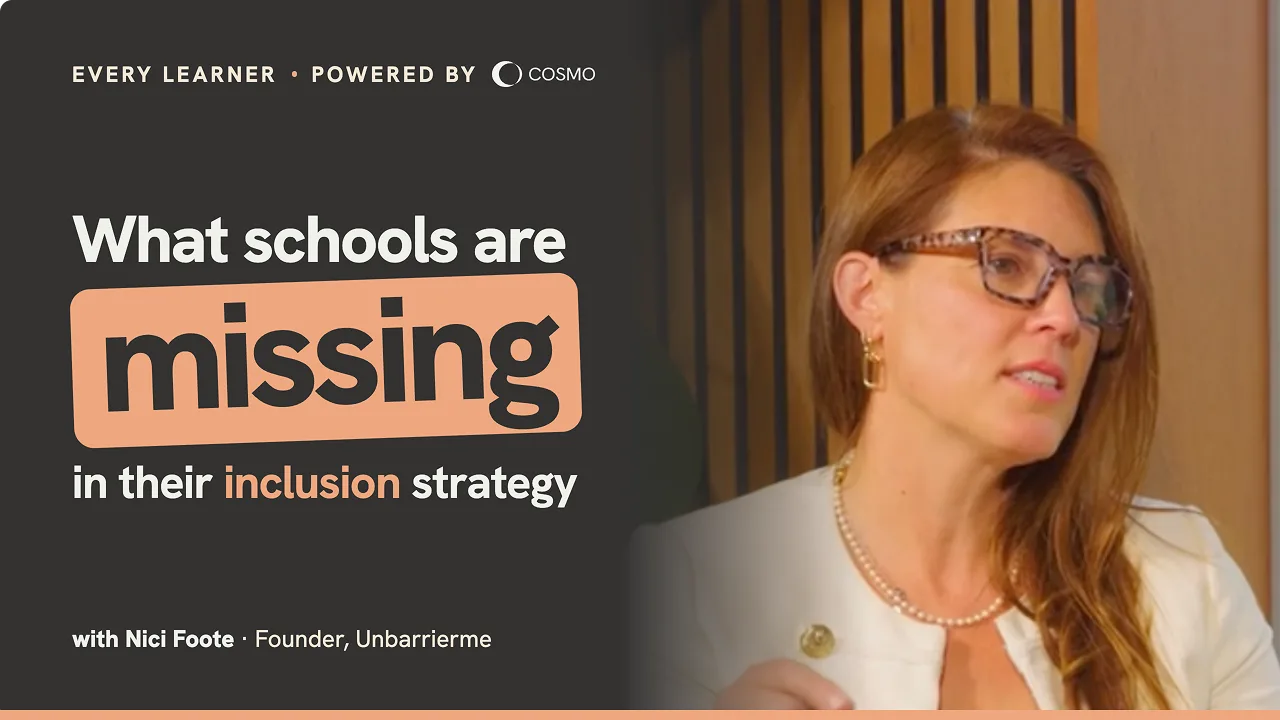
Every mainstream school has new inclusion funding to plan and a strategy statement to publish by 31 December. On the Every Learner podcast, Nici Foote of Unbarrier Me explains why the best first move is to pause, and why belonging should be at the heart of the plan.
The money has landed. The deadline is set. And the to-do list just got longer.
That’s exactly when things go wrong, says Nici Foote. A new pot of money quickly becomes a tick list or a spending spree. “Please don’t do this. From my heart to yours: pause.”
In this episode, our host Ana asked Nici the question that matters most: will this money actually reach the pupils?
Year one is for understanding, not spending
The DfE’s Inclusive Mainstream Fund is going to mainstream primary and secondary schools, and each school must publish an inclusion strategy statement on its website by 31 December.
Nici sees inclusion as “a whole-school problem. It is not specifically a SEND problem.” So year one is about setting a baseline: what you have, what you need to uncover, and where you want to be in five years.
There’s no rush to spend, either. “Do not feel the need to spend that money,” she says. Her favourite plan B is to work to the window that runs to the end of March 2028.
Choose two or three principles, and start with belonging
The DfE’s seven principles are “not a tick list”, Nici says. “Look at two or three really core ones” that connect to your school development plan.
Her first choice is belonging, alongside principle one on strong leadership and governance. How will your community define belonging? How does it show up now? What does great data on belonging look like?
For Nici, this is personal. She was diagnosed with dyslexia at ten, and with ADHD, dyscalculia and an auditory processing disorder at university. “I didn’t feel that I belonged in that classroom,” she says. Ana, whose childhood eye cancer kept her out of school for a long time, knows the feeling.
Belonging, says Ana, is “not sprinkles on top of the cake”. It is, says Nici, “the roots that help us to grow”. When pupils feel frightened or put on the spot, she explains, “our brain will find a way to not participate.”
Look for the pupils you don’t see
Nici reads the fund as whole-school money for every pupil, not a SEND budget. That puts the spotlight on children who will never meet the SEND threshold: bright pupils who overwork to stay on top, or hide behind their behaviour.
Nici was one of them. “I loved the goldfish at the back of the class,” she remembers. She would turn up late and spend ages sharpening her pencils.
So notice the patterns. Why is one pupil always late on a Tuesday? Probably because that’s when the class reads aloud. Why do some never get an enrichment place? Perhaps because sign-up opens at five o’clock on a Wednesday.
“It’s not what we see every day,” Nici says. “It’s what we don’t see.”
Ask the pupils
Schools are good at asking teachers, Nici says, “but do we ask the students?” That means real conversations about what changed in their learning and how it feels, not just a Google Form.
It’s something we take seriously at Cosmo. Whenever we pilot something new, whether for SEND, mainstream classrooms, Reception or music, we’re careful about what we measure. With younger children, that often means watching how they react when the activity comes out. Without engagement, as Ana puts it, “it’s not going to go anywhere.”
Nici, who has worked with Cosmo for a couple of years, has seen what inclusive activities can do. In one school, “it was the first time that certain children could be in the room together”. For teachers and pupils, she says, that is “absolutely phenomenal”.
Why edtech ends up in the cupboard
Ana sees it on school visits all the time: technology that “just never gets used”. For Nici, it comes down to capacity. Do teachers have the headspace to learn a new tool? Were they part of the decision?
She points to the DfE’s November 2025 technology in schools survey. Access to assistive technology jumped from 34% to 60% of primary teachers, yet 39% of teachers didn’t know either way whether it was fit for purpose, and only 22% of leaders had a formal plan to evaluate it.
Then there are the practical questions: who keeps it charged, and who books it for 3B on a Tuesday? That’s why, years ago, plug and play became a priority for us at Cosmo, along with training that fits a teacher’s day. “We exist to serve the students,” Ana says, “but we also exist to serve the teachers.”
Nici’s advice: look at what’s already in your cupboards, ask why it didn’t work, and give teachers and TAs a real voice in the strategy.
MATs: divide and conquer
Trusts are “winner, winner, chicken dinners”, Nici says, because they can pool resources: one template for every school, mapped to the trust’s vision, with every leader briefed the same way. Each school still writes and publishes its own statement. Smaller schools can team up through their local authority or school networks.
Good evidence, and capability over capacity
For evidence, Nici starts with the Education Endowment Foundation, then asks how research relates to your own classrooms, local data and case studies. “For me, the not knowing is more important than everything else.”
Ana adds that evidence has to feel relatable. That’s why our case studies show the reality of each setting, so teachers recognise their own classroom: “My kid does that.”
And because the fund won’t last forever, Nici’s message is to invest in people. “It’s not about buying capacity… It is about buying capability.” Make teachers, TAs, governors and pupils more capable, test what works, and let next year’s statement build on this year’s.
Three things to do before December
Aim for early December: “No one’s going to be uploading a statement between Christmas and New Year.”
- Set your baseline now, including pupil voice, so you can compare like for like next year.
- Narrow your principles to two or three. “For me, less is more on this one.”
- Write about what you don’t know: the barriers you haven’t uncovered, and the pupils who are cruising or easily forgotten.
Does every learner feel they belong?
Ana closed the conversation with one question for every school leader and teacher:
“Does my learner feel like they belong, and am I doing all I can so that that happens?”
Listen to the full episode of Every Learner with Nici Foote
About Nici Foote
Nici is the founder of Unbarrier Me, an inclusion and accessibility consultancy working with head teachers, senior leaders and trusts.
Experience Award-Winning Inclusion
Cosmo helps schools build the foundations that learning depends on. Our interactive learning system brings movement, play and multi-sensory activities into the school day, so every learner can engage, participate and belong.
Explore the Cosmo Learning System